Exploring Black Holes with WebGPU
Sergei Almazov2 min read

Last weekend I rebuilt a personal black-hole visualization playground—and it turned into one of the most rewarding technical explorations I’ve had in years.
Not long ago I created a black-hole scene in Blender 4.5, where high-fidelity rendering convincingly captured relativistic lensing and accretion detail. Of course, real-time web technologies aren’t quite there yet. But I asked myself: how close could I get, using only modern web tooling?
Why WebGPU? WebGPU—the successor to WebGL—introduces compute shaders, closer-to-metal GPU performance, and a modern graphics pipeline. It brings into the browser simulations once reserved for native engines like Unreal, Unity, or CUDA.
From the very first frame, it felt like stepping into a new era. Clean shader code ran blisteringly fast in the browser. React and Vite stayed unobtrusive, enabling hot reloads, lean configuration, and a developer experience that let me focus on physics realism rather than plumbing.
With a help of ChatGPT Codex in just a one week I was able to:
- Simulate relativistic lensing, accretion disks, and dust spirals around a black hole.
- Tune particle systems for meteor trails and comet tails—all in a web context.
- Build a multilingual control surface and cinematic intro timeline without sacrificing GPU throughput.
- Make a mobile version support for modern smartphones and tablets
- Prepare a project and deploy it to Vercel
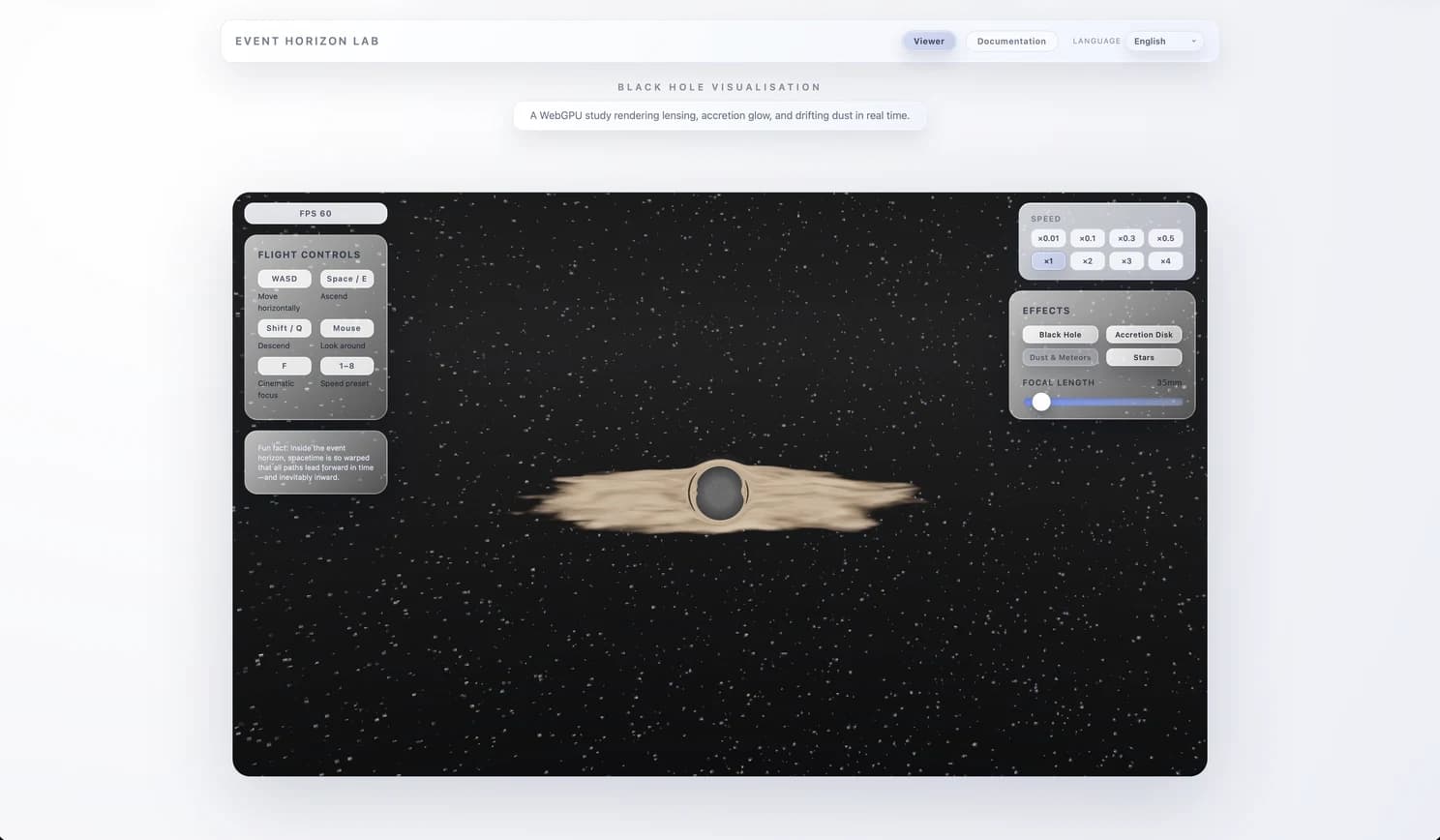
What stood out most is how much “desktop-class” visualization work is now feasible on the open web. WebGPU’s API design is consistent, the ecosystem around it is maturing quickly, and deploying highly interactive experiences is suddenly within reach for small teams—or even an after-hours passion project.
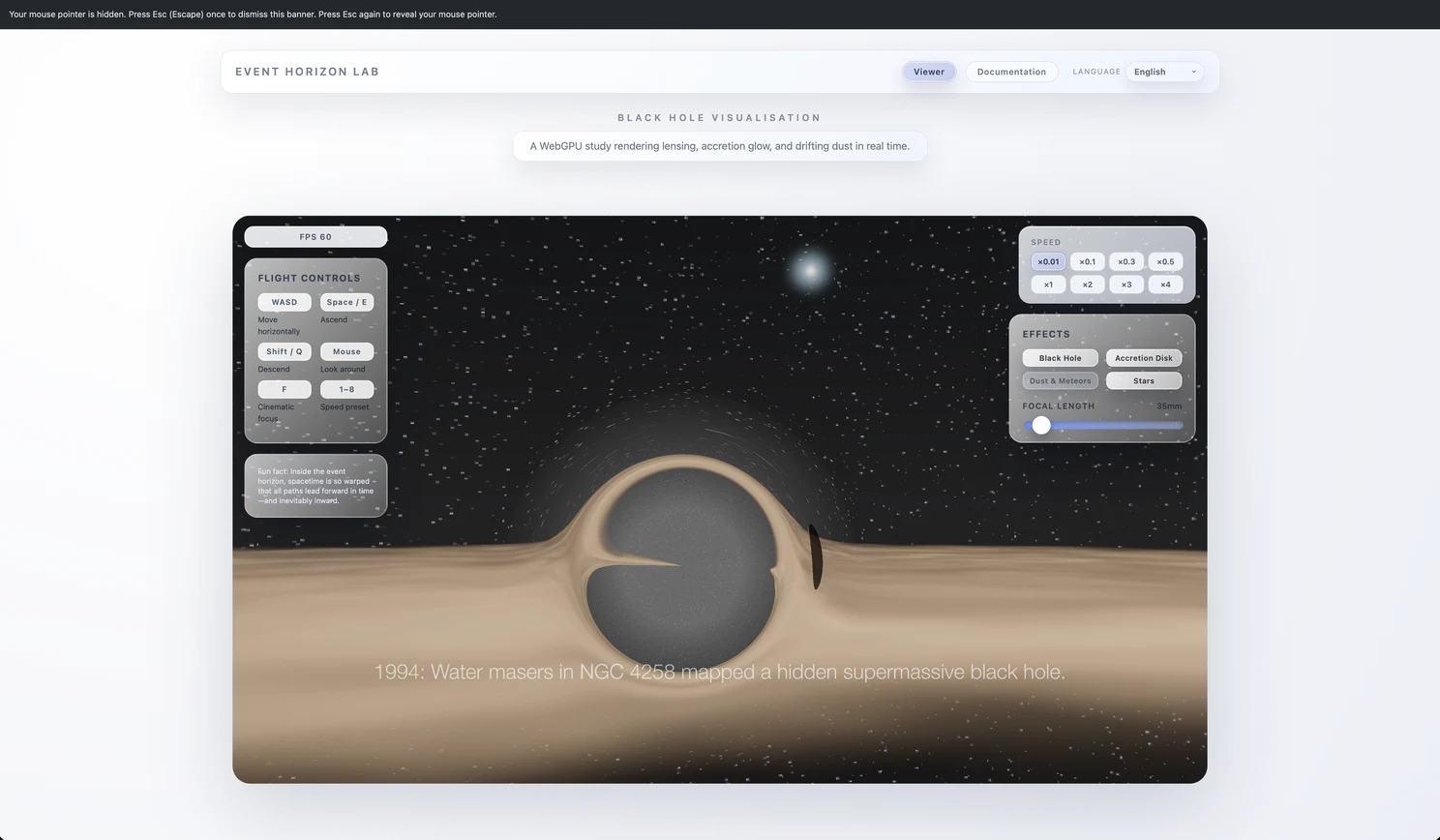
For technical leaders asking whether the browser is ready for serious visualization and simulation: my answer is an emphatic yes. WebGPU, paired with React and Vite, provides a rapid feedback loop and a compelling platform to prototype, demo, and ultimately ship sophisticated experiences—without requiring users to install anything.
I chose to deploy on Vercel, as it provides a fast, reliable way to launch front-end projects with minimal friction. The free plan is more than enough for publishing experiments, proofs of concept, or early MVPs.
The gravity of WebGPU is undeniable—and I’m excited to see where it takes us next. Feel free to explore the demo yourself here. And who knows, maybe it's time to rewatch "Interstellar" once again!